Drawing Robot With Cards Explained: A UK Buyer's Guide
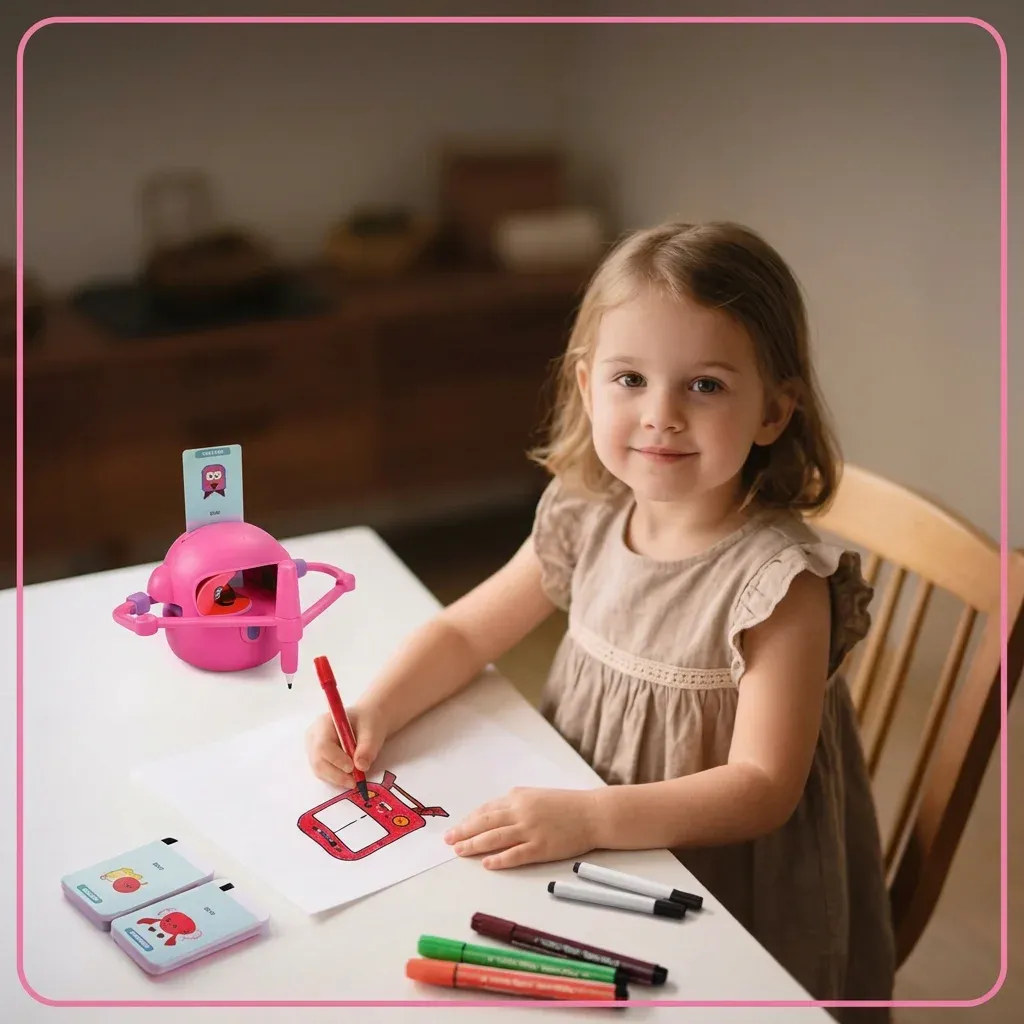
TL;DR: A drawing robot with cards is a screen-free educational toy that reads scannable flashcards to instruct a robotic arm to draw images step-by-step. Based on our testing at KidsDrawin, this tactile system aligns perfectly with UK EYFS guidelines by replacing digital screen time with hands-on, fine motor skill-building play.
Key Takeaways
- A drawing robot with cards uses physical flashcards containing hidden codes (like RFID or optical markers) to instruct a robotic arm on what to draw.
- This tactile, card-based system provides a completely screen-free educational experience, aligning with UK guidelines for reducing early childhood screen time.
- The physical act of selecting, inserting, and sorting the cards helps develop fine motor skills and hand-eye coordination in young children.
- When purchasing in the UK, parents should look for the UKCA safety mark, durable card materials, and clear English voice guidance.
If you are wondering what a drawing robot with cards is, it is an innovative educational toy that genuinely engages children by reading physical flashcards to automatically draw images without relying on digital screens. As tablets and smartphones become deeply embedded in daily life, based on our in-house testing at KidsDrawin, the demand for tactile, physical play has surged amongst British parents. Enter this brilliant intersection of traditional flashcard learning and modern robotics.
Furthermore, rather than tapping an app, children interact with these toys by physically selecting a card, scanning it with the robot, and watching as a mechanical arm draws the corresponding image step-by-step. Consequently, it is a highly interactive process that transforms passive observation into active participation.
This guide explores exactly how these card-based systems work, the cognitive benefits of tactile learning, and what UK buyers need to look for to ensure they are getting a safe, high-quality product that aligns with Early Years Foundation Stage (EYFS) developmental goals.
How Does a Drawing Robot With Cards Work?
At first glance, a drawing robot might seem like a complex piece of engineering. However, the mechanism driving a drawing robot with cards is designed to be incredibly intuitive for children as young as three years old.
How Do the Scanning Cards Function?
The magic lies in the flashcards themselves. Indeed, these are not standard pieces of cardboard; they are embedded with specific data that the robot can read. Based on our product evaluations, most premium models use one of two technologies:
- Optical Recognition (Barcodes or QR Codes): The back of the card features a unique visual code. When the child holds the card up to the robot's "eye" (a small camera or scanner), the device instantly recognises the design.
- RFID (Radio Frequency Identification): Some advanced models use hidden chips inside the cards. The child simply taps or slots the card into a designated area on the robot, which reads the chip via radio waves.
Once the card is scanned, the robot's internal processor accesses the specific drawing file associated with that code. The robotic arm, holding a standard pen or marker, then executes the drawing on a piece of paper placed beneath it. For a broader look at how these devices operate, you can read our comprehensive doodle robot toy overview.
Can the Robot Teach Step-by-Step Drawing?
The true educational value emerges in how the robot executes the drawing. Importantly, it does not simply print the image in one rapid motion. Instead, it breaks the image down into basic geometric shapes and lines, pausing at strategic intervals. Therefore, this methodical approach demonstrates to the child exactly how complex pictures are constructed from simple components.
Moreover, during these pauses, a high-quality voice guided drawing robot will speak to the child, offering encouragement, explaining the current step, or asking them to copy the line that has just been drawn. The physical card remains visible as a reference point, providing a clear "end goal" for the child's artistic efforts.
What Are the Educational Benefits of a Drawing Robot With Cards?
Why use cards at all? Manufacturers could easily build a screen into the robot's chest to select images. However, the decision to use physical cards is deeply rooted in childhood developmental psychology and the specific needs of early years education in the UK.
Does It Help Reduce Screen Time?
The most immediate benefit is the elimination of screen time. According to UK guidelines from the Royal College of Paediatrics and Child Health (RCPCH), parents are advised to manage screen time carefully, ensuring it does not displace physical activity, sleep, or face-to-face interaction.
"According to Ofcom's 2023 Media Use and Attitudes Report, 99% of UK children aged 3-17 go online, with children aged 3-4 spending an average of 15 hours a week online. This data underscores the urgent need for engaging, non-digital alternatives in the early years."
Consequently, a drawing robot with cards offers the "tech" appeal that children gravitate towards, but grounds it entirely in the physical world. The child is looking at paper, manipulating cardboard, and holding a real pen.
How Does Card-Based Play Improve Fine Motor Skills?
Handling the cards is an educational activity in itself. According to the EYFS statutory framework in the UK, significant emphasis is placed on physical development, specifically fine motor skills. When a child engages with a card-based drawing robot, they are performing several precise physical tasks:
- Pincer Grip: Picking up individual cards from a stack requires a refined pincer grip, which is the foundational muscle movement needed for writing.
- Hand-Eye Coordination: Aligning the card accurately with the robot's scanner or slot demands focused hand-eye coordination.
- Sorting and Categorising: Children naturally begin to sort their physical cards into piles—animals, vehicles, letters, or numbers. In fact, this physical sorting is a critical early maths skill that cannot be replicated by scrolling through a digital menu.
What Types of Cards Are Included?
A high-quality drawing robot with cards will come with a diverse library of flashcards, ensuring the toy grows with the child. When evaluating and choosing a doodle robot toy in the UK, we strongly recommend inspecting the variety and educational scope of the included card sets.
1. Foundational Drawing Cards
These are the core cards designed to teach art. They typically feature animals, everyday objects, vehicles, and nature scenes. The best sets start with very simple shapes (like an apple or a sun) and progress to more complex figures (like a dinosaur or a fire engine). Because it acts as a step-by-step drawing toy, children learn that complex illustrations are just combinations of simple lines and curves.
2. Phonics and Literacy Cards
Many UK-focused drawing robots also include the alphabet. As a result, the robot will draw the letter (demonstrating the correct stroke order, which is vital for early handwriting skills as outlined in the UK national curriculum).
Ready to try KidsDrawin for screen-free creative play?
Shop Now — £41.66